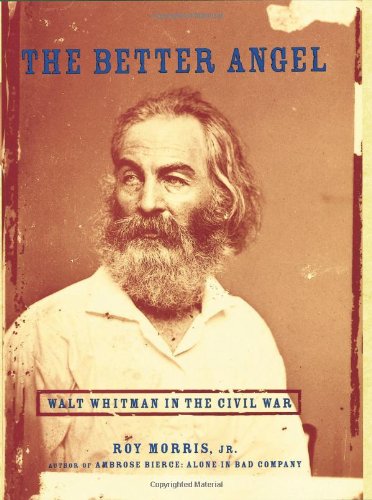
The better angel

Walt Whitman in the Civil War

By Morris, Roy

Publishers Summary:
"Of the Civil War's many stories of heroism, few are so unlikely, or so moving, as that of Walt Whitman. For nearly three years, Whitman tended to legions of sick and wounded soldiers, immersing himself in the devastation of the war and recording his experience with an immediacy and compassion unequaled in wartime literature anywhere in the world.". "In The Better Angel, acclaimed biographer Roy Morris, Jr. gives us the fullest account yet published of Whitman's Civil War years, which transformed him both as a poet and as a person. As the war began, Whitman was mired in depression, subsisting on journalistic hackwork and wasting his nights in New York's seedy bohemian underground. But when the news came that his brother George had been wounded at Fredricksburg, Whitman rushed south to find him. Though his brother's injury was slight, the poet was deeply affected by his first view of the war's casualties. He began visiting the camp's wounded and, almost by accident, found his calling for the duration of the war.". "The wounded, he wrote, 'opened a new world for me... bursting the petty bonds of art.' He visited them daily, bringing gifts of ice cream, tobacco, or books; wrote letters for them; and offered to all the healing influence of his sympathy and affection. Indeed, several soldiers later said that Whitman had saved their lives. But if Whitman gave much to the soldiers, they in turn gave much to him. In witnessing their stoic suffering, in listening to their understated speech, and in being always in the presence of death, Whitman evolved the new and more direct poetic style that culminated in his masterpiece, 'When Lilacs Last in the Dooryard Bloom'd.'"--BOOK JACKET.

 Not Rated. Be the first to rate this product!

ISBN
978-0-19512-482-8
Publisher
Oxford ; Oxford University Press, 2000.


REVIEWS

School Library Journal

Reviewed on October 1, 2000

YA Morris notes in his introduction that Whitman, no stranger to the practice of using precise vocabulary, claimed he was "saved" by the Civil War. The author explains his subject's salvation by tracing the effects of crisis and suffering on one man's spirit and artistry. Since this was also the man who articulated America's voice in his groundbreaking Leaves of Grass, Whitman's evolution personified that of the country he celebrated and loved. In 1860, the poet was feeling cynical and un...Log In or Sign Up to Read More

Become a Pro


This feature is only available to Pro subscribers. Please log in, or upgrade your subscription.

Add To My List

cover
by

This feature is only available to Pro subscribers. Please log in, or upgrade your subscription.

Export


This feature is only available to Pro subscribers. Please log in, or upgrade your subscription.

Save List Search Query


This feature is only available to Pro subscribers. Please log in, or upgrade your subscription.

Follow Lists


This feature is only available to Pro subscribers. Please log in, or upgrade your subscription.